Author: Onnivation

5March 2024

Data Privacy as a Revenue Driver

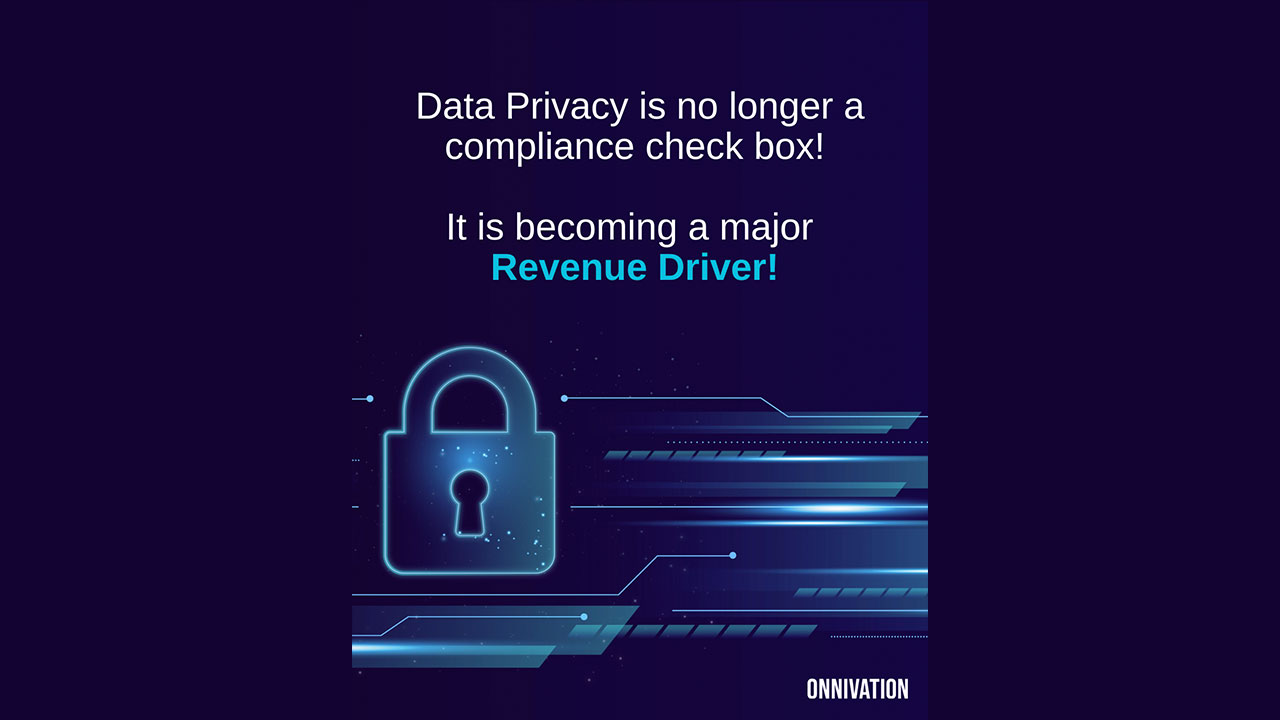
Data Privacy is no longer a compliance check box, but is rapidly evolving into a Revenue Driver

A fundamental shift in the Data Privacy landscape is underway

Data Privacy is no longer a compliance check box, but is rapidly evolving into a Revenue Driver as it dictates customer trust, competitive differentiation, customer acquisition and retention.

A few trends and statistics demonstrate this major shift:

  1. Customers are becoming increasingly intentional about what types of data they share, with whom, and only for specific, relevant purposes; and they want a ready-to-view record of it.

    According to a 2022 OpenText India survey, more than a quarter of consumers (27%) said they would no longer use or buy from a company they were previously loyal to if it failed to respond to a Data Subject Access Request (DSAR) — formal requests made by individuals to companies to modify, access, or delete their data.

    Three in ten (31%) said they ****would no longer use or buy from a company if it shared their personal data with third parties for anything other than its specified purpose.

  2. Customers are regularly inundated with news of high-profile consumer-data breaches dominating news cycles over the years such as:

    The 2018 breach of 1.1 billion Indians’ AADHAR data, and

    The 2019 Facebook breach that exposed the PII of 533 million users.

  3. Customers (both existing and potential) now pay attention to:

    A) How much importance organizations give to protecting their data, and

    B) How well they communicate it.

    A 2023 survey by Home Credit India found that 70% of the surveyed borrowers expressed the need for transparent communication regarding the usage of personal data.

    A 2022 survey by Opentext in India concluded that 83% of consumers would be willing to pay more to use or buy from an organization that has explicitly committed to protecting personal data.

  4. Certain industries matter more to customers: In a 2023 LocalCircles India survey, 69% of consumers held banks and financial services providers responsible for the breach of personal data. 75% said Telcos were responsible for the same.

  5. There have also been multiple reports of the rise of Data Brokerage: the practice of buying, aggregating, selling, licensing, and sharing individuals’ data in an online marketplace.

  6. Customers are now willing to pay for personal data visibility software (and some already are) to give themselves more control and visibility of their data like DeleteMe and Incogni which allows them to monitor and wipe their personal data from the internet.

    2022 also saw a 72% increase in the total volume of Data Subject Requests (DSRs) compared to 2021, with deletion requests as a primary driver for the increase, according to Datagrail.

The Bottomline:

Consumers now evaluate a brandʼs reputation on data privacy in the same way as they judge more traditional factors such as the quality of product or service. Therefore, the cost of a data privacy failure will be felt directly on the revenue column and not just in the form of regulatory fines.

This is a significant challenge, given that a recent EY India survey revealed that 50% of the surveyed organizations are yet to acquire the required skill sets to implement the DPDP Act.

However, with the right guidance and capabilities, this is a huge competitive differentiation opportunity for those that can get Data Privacy right. Here’s what companies can do to achieve that:

  1. Formulate and lay out a transparent Data Privacy Policy that is not only compliant with the latest privacy regulations, but also explicitly communicates how the company collects/manages data at every stage of customer engagement and who it shares it with.
  2. Build an efficient consent management process and a live data inventory system in partnership with a trusted technology partner that has a deep understanding of how Privacy works. Acquiring and retaining customers is already an expensive endeavour, thus having clear consent management and the ability to respond to DSRs is of enormous consequence to revenue.
  3. Fortify your tech stack with a comprehensive Cyber Security strategy to prevent and respond to data breaches. If a serious data breach occurs, promptly report it to the relevant authorities such as the Data Protection Board in India. Prompt intimation not only prevents major regulatory fines, but also signals to the customer that you are transparent in your dealings with their data.
  4. Reassure customers that the misuse of their data would be prevented at all costs. This could be done using notices, media releases, and statements made my senior leadership in the news.
  5. Get accredited from third-parties/standards bodies that validate your practices and people (i.e. SOC/ISO2, PrivacyTrust Certification, CIPP, CIPM)

All in all, treating Data Privacy as a pejorative for compliance teams simply isn’t enough anymore.

Having a comprehensive data privacy and security strategy as well as managing the customer perception around it will be the holy grail in any data fiduciary’s quest for customer retention and acquisition to increase their top-line. Brands seen as guardians of personal data will not only safeguard themselves from legal repercussions, but see a measurable impact on revenue.


Recent blogs

23June 2022

Delivering solutions to problems you haven’t yet encountered


“…there are known knowns; there are things we know we know. We also know there are known unknowns; that is to say we know there are some things we do not know. But there are also unknown unknowns — the ones we don’t know we don’t know.”

Donald Rumsfeld

Every day, business leaders are faced with complex situations: What will be the sales next year? Will the new product succeed? How will the competition react to the move we just made? However, the most challenging situations are often totally unexpected because they are impossible to forecast. The size and scale of these uncertainties are imperceptible.

While technology can help identify and solve many of these unknowns, the familiar way of doing things, the tech infrastructure and the tried and tested methods restrict a company’s response to adopting new technology, thereby creating inertia.

At Onnivation, we understand that ‘tech inertia’ can be a direct outcome of the battles businesses fight on many fronts to stay competitive and relevant. Our goal is to help you stay one step ahead of the game by identifying and addressing the root causes of the battles and developing a comprehensive war strategy.

We start by directly confronting the uncertainties. What’s hurting the business the most? The usual responses may be ‘dip in sales’, ‘low conversions’ or ‘increasing costs’. But we don’t stop there, we work with you to understand the root cause of these problems. The problems you know you are facing or the ones you never knew existed. 

Take cloud optimisation, for example. With a plethora of cloud compute pricing models, selecting the optimal path to cloud cost efficiency is not straightforward. So, while most companies accept their cloud costs as is, we work with our partners to recommend and implement solutions like Spot.io to help them with the greatest cloud compute cost efficiency with the potential of up to 90% savings in AWS and Azure and 79% in GCP. 

Another classic example would be the cost per acquisition or shopper. While running promotions for marketing is not a new thing for any enterprise, more than 97% of shoppers are abandoning the journey before they make a buy. Businesses are doing everything they can – non-stop segmentation, endless A/B testing – but it’s just too hard to figure out what each shopper wants, which is why nearly all of them give up and walk away. That’s where solutions like Namogoo.com come in: a personalised promotions platform to deliver 10x ROI and 15% revenue growth as soon as you start using it. What’s more, it creates a favourable brand imprint in the customer’s mind with its intrusion-free solutions.  

Applause for us is the ultimate customer-centricity tool that has completely changed the perception of how Quality Assurance (QA) should be done. While in-house QA teams can help diagnose and solve problems on a continuous run, the sheer magnitude of usage in real-time can be a mammoth task no matter how big the company is. How Applause helps maintain the efficacy and efficiency of a software is by delivering authentic, real-world feedback through a global community of digital experts. Curated teams share the workload with your company’s internal QA team from remote locations, to ensure your digital assets are performing at its finest and your customers are enjoying the experience your software was designed to deliver. In short, Applause helps your business take a bow to your customers, making them come back for more.   

At Onnivation, we understand that the ‘unknown unknowns’ can hold businesses back from their true potential. How Onnivation sheds a flashlight in the darkness is to find solutions for problems companies didn’t know they had. It’s why we bring strategic foresight into the picture – knowing what’s needed even before it’s needed. Like the saying goes; you’ve got to build the well before you need the water. Foresight breeds innovation and innovation pays off only with a partner who understands your business goals end-to-end. Knowing what a company needs in order to scale-up in an aggressively competitive ecosystem of SaaS mavericks is what we provide all our partners.

That’s where our ‘innovation culture’ can be the guiding light. In moments of extreme uncertainty, where most businesses fear ‘downsides to innovation’, we at Onnivation ask; “what can we create out of nothing?” In fact, we’ve curated 15 portfolio companies who can enhance your existing tech stack or even help identify new technologies available across the India-Israel corridor that solves your immediate problems. Onnivation can help you breed the innovation culture in your company. Always keeping you looking to the future without fear.  

7June 2022

Yes, no, maybe! Do you know what your customers want?


We have all heard the original 4Ps of marketing – product, pricing, place and promotions. Over time, with the addition of ‘people’ in the mix, it became the 5Ps! Now there are 7Ps or 8? Why are the Ps suddenly accelerating?

The world is comprised of data, and lots of it too. It is a constant process to distil this data into information, and information into actionable knowledge. As business intelligence becomes more accessible, companies can make more reliable correlations between previously unrelated variables; thereby adding veracity to their decision-making.

It’s the newest frontier in this data revolution. Companies and their marketers can now use exceptional BI tools to better understand customers and their digital journeys; from discovery to decision of purchase, from awareness to loyalty towards the brand, and from intent to action.

However, with new paradigms arise new challenges. Digital democracy has given rise to a new breed of customers – the “digital drifters” who are more ‘price loyal’ than ‘brand loyal’, face decision paralysis and get actively hijacked by product competitors. This means that companies are now seeing unpredictable heart to cart journeys due to the sheer amount of choices and options available for web commerce. Moreover, with governments becoming cognizant of the digital rights of their citizens, companies no longer have unprecedented access to their potential customer’s historic behaviour. When this is contrasted with the finding that “80% of customers are likely to make a purchase when their experience is personalized” (Epsilon study, 2018), companies are in a paradoxical situation where the only sure way of customer conversion is personalization, but personalization is extremely difficult due to privacy policies.

How does one resolve the paradox? 

Enter new-age tools like Namogoo that allow companies’ marketing efforts to stay above board while ensuring that your bottom line smiles. By using non-personally identifiable information (PII) data, such tools enhance customers’ shopping experience by creating unique journeys for unique customers. Such unique journeys have led brands to achieve a huge reduction in promotion costs while achieving a significant increase in revenue.

Namogoo especially does this by accessing 2,000+ data sources (none of which are third-party cookies) to understand customer behaviour and intent in real-time. Using this information, Namogoo has helped retail brands like Asics, Samsonite and Dollar Shave Club to improve their brand perception, create brand loyalty and on the way improved conversion rates. Namogoo collects data, recognizes a shopper’s triggers and relays that information back in real-time to Ops teams thereby, helping brands decrease cart abandonment, and helping customers decrease the time for purchase. 

Tracking ‘Intent’ the Namogoo way

Customer Behaviour 

Namogoo collects data about shoppers’ purchasing patterns, shopping journey, traffic source, content viewed, browsing patterns and shopping intensity to create a customer personality profile that its platform can use for hyper-personal promotions. 

Device & Environment 

For most e-commerce businesses, obstacles that prevent customers from completing an online purchase, directly impact revenue. Namogoo takes care of the biggest of these obstacles by effectively collecting non-PII data such as device type, network type, browser data, geo-location (region) and more, to reduce the likelihood of cart abandonment.

Website & Product Data

By tracing purchase & customer behaviour trends on the website, Namogoo offers recommendations to companies on how to improve customer journeys. This helps them become continuously smoother and more efficient in terms of conversions.  

Brand results with Namogoo

10x increase in average ROI in 1st month

15% instant boost in digital revenue

25% less spend on promotions

With numbers like these, businesses can finally turn their focus back to presentations, and let tools like Namogoo do the heavy lifting!

Sources:

https://www.adverity.com/data-driven-marketing#:~:text=Data%20helps%20to%20gain%20better,to%20predict%20customer%20behaviour%20further

https://www.forbes.com/sites/paultalbot/2021/10/22/how-data-will-shape-the-future-of-marketing/?sh=6a2402b869d6

https://www.coredna.com/blogs/digital-customer-experience-trends

https://www.namogoo.com/blog/in-the-age-of-gdpr-how-can-you-leverage-non-personalized-data/

https://mediatrust.com/customer-journey-hijacking/

https://www.latentview.com/non-pii-data/#:~:text=Non%2DPII%20data%2C%20is%20simply,%2C%20bio%2Dmetric%20records%20etc

27May 2022

Your 10 min delivery system can go haywire in a nanosecond.


A global market survey of the log management market found that medium sized enterprises generate about 100s of gigabytes of data or more than 20 million logs per day. So it becomes pertinent to investigate and understand why businesses would spend resources on generating, storing and managing such high volumes of data. 

While digital transformation is the norm for most new businesses, the recent pandemic has accelerated the number of access points and endpoints for users and businesses, leading to a rapid increase in event log data. For instance, grocery delivery apps like ‘Blinkit’ and food delivery apps like ‘Zomato’ have recently developed under 15-minute delivery models. Such models require rigorous planning and forecasting to identify demand centres, plan inventory and identify the location of supply nodes. This information needs to be identified and analysed for quick decisions, continuous improvement, and staying upbeat to the competition. This is impossible to do without creating logs.

The other big driver for log creation is to effectively analyse internal and external threat patterns – which covers the entire gamut from predicting downtime to discovering cybersecurity vulnerabilities. The scale of the downtime problem is so high that in the US, on average over 8,500 websites are reported to have an outage every hour (source). Amazon had a 40-minute downtime in 2013, which costed them USD 3.2 Million. Google, which also went down in the same year, lost about USD 0.6 million per minute during the 5-min downtime. In terms of cybersecurity, as of 2020, the average cost of a data breach was USD 3.86 million. This was because the average time to identify and contain a breach during the same period was a staggering 280 days. Creating threat intelligence by analysing logs can reduce downtime and reduce the time taken to identify a cyberattack, thus preventing huge losses. 

To sum up, logs play a key role in understanding your system’s performance and health. Observability generates a true view of the system at any given point using a record of critical errors encountered by a running application, operating system, or server, and visualising them through interactive dashboard views. Further, AI and machine learning tools to infer information from the volume and flow of logs can automatically find the root cause of issues and surface anomalies to help organizations prevent an issue even before its occurrence.

Let’s take a deeper dive into the use-cases of log analysis: 

Understanding the online user behaviour

With the help of log analysis, companies can re-create the exact journey of consumers in making a buying decision. These metrics can help in understanding the consumer behaviour and trends which aid in –

  • Spotting opportunities to send notifications or newsletters to users at the right time and of right-products
  • Managing the traffic loads
  • Determining the traffic trend to plan down-time and maintenance

Improving operational efficiency

Application crashes are often listed as key reasons in the consumer churn rate. With the help of log analysis, the detection of system errors becomes faster and thus, critical issues can be resolved quickly improving the overall operational efficiency.

Improving cyber security

Logs are the most easily accessible method to track attackers as they contain important information such as IP addresses, client/server requests, HTTP status codes, and more. Log analysis can flag the detected anomalies so that the companies can quickly intervene and eliminate the threat

Ensuring compliance with security policies

All organisations that have payment integration are subject to multiple standards and industry guidelines to guarantee safety and functionality. Many are even required to log the data and analyse it regularly. This protects organisations against threats and also shows their willingness to comply with ISO, General Data Protection Regulation (GDPR), Health Insurance Portability and Accountability Act (HIPAA), Sarbanes-Oxley, PCI DSS, and other standards.

Why Coralogix?

Coralogix is a Tel Aviv-founded and now San-Francisco based observability tool that boasts of a customer roster of some of the largest and most innovative companies in the world. The key differentiators that set Coralogix apart from other log analytic players in the market today are:

Proactive and real-time log tracking

Coralogix instantly clusters millions of entries in real-time which can help companies troubleshoot bugs or customer queries quicker than anyone else. This is especially essential in today’s technology immersed world.

A revolutionary methodology for observability

Coralogix has several capabilities that make querying logs an enabler for observability by creating a real-time streaming analytics pipeline that provides monitoring, visualization and alerting capabilities.

Unique architecture to Ingest, Analyse & Index

The Coralogix Platform has created a patented Streama© technology that provides real-time insights and long-term trend analysis for better data prioritisation, thereby leading to better and faster decision making.

Effortless set-up and adoption

Coralogix has a plug-and-play set up for seamless implementation, and is the only platform that mandates an end-to-end ownership within their customer support to drive adoption and expansion for customers. By enabling users to define different data pipelines as per usage, Coralogix provides customers with deep insights for less than half the cost.

20December 2021

Move over Silicon Valley, Silicon Wadi is here!

‘Disruptive innovation’ is Israel’s most valuable contribution to global businesses. Israeli deep tech companies are changing the way corporates think, plan and grow.

Israel’s startup scene is booming! With a population of approximately nine million and home to some 6,500 start-ups, Israel has the largest number of startups per capita in the world. The country is well on course to transition from ‘start-up nation’ to ‘scale-up nation,’ with 40 plus Israeli-founded Unicorns.

250 foreign companies have set up R&D centres in Israel. More than 150 Israeli deep tech companies are engaged in advanced research and futuristic tech breakthroughs. Strengthened by government incentives, low-rate loans and the availability of highly trained human capital, Israel has become an attractive location for the research centres of leading multinationals.

But how did a tiny Mediterranean country get this distinction?

Israel has attracted a significant number of well-educated and well-trained immigrants from European and North American countries ever since declaring its statehood in 1948. Jewish investors from all over the world helped build universities and research institutions in Israel. It thus developed a core competency in advanced technologies as early as the 1960s. Israel’s start-up industry, which developed in the 1980s and ‘90s, has gradually evolved into a hub for deep tech innovation.

Many of Israel’s deep tech companies are founded by former members of the country’s elite military intelligence units. Students in Israel are exposed to advanced computer studies as early as age 13, and the pressure to become a techie is strong. Mandatory military service, quality education, risk tolerance, and a team-oriented atmosphere make Israel a fertile breeding ground for fast-moving tech companies.

Today, Israelis are reimagining and reshaping almost every sector, including cybersecurity, biotech, AI/VR, energy, machine learning, agritech, aerospace, defense and more. Increasingly, global tech giants are turning to Israeli deep tech companies for innovation work that impacts their core businesses. Israel’s list of ‘Big 10’ tech clients includes US-based Microsoft, Amazon, Google, Facebook, Apple. China’s Alibaba and Baidu and South Korea’s Samsung are also major players in Israel’s tech ecosystem. About 300+ other multinationals are also currently engaged with Israeli innovation.

Israeli startups too are widening their horizons. The US has traditionally been a huge market for Israel and continues to be a mainstay. Currently, over 900 Israeli start-ups operate in 28 countries throughout Europe, with 405 firms in UK alone, followed by Germany and France. There is a huge opportunity for Israel in Asia too, particularly in fast-growing sectors like automotive, cybertech, AI, fintech, IOT, telecoms and biotech.

Backed by Israeli deep tech, Asian companies can accelerate growth and focus on their core competencies. Onnivation helps bridge the gap between Israeli deep tech companies and the ASEAN companies with its unique, high impact and low-risk model.

6December 2021

Acquire Israeli deep tech talent with Onnivation’s Acquihire solutions

Successful companies know that a high-performing team is worth its weight in gold. Backed with the right talent, your billion-dollar ideas can get the wings they need to takeoff.

With the recent wave of investments in the tech sector this year, nearly 7 in 10 companies have reported talent scarcity and difficulty hiring for tech roles. Acquihiring is an effective solution for large enterprises, new-age digital companies as well as early-stage startups to overcome hiring challenges and achieve scale.

As the startup capital of the world, a staggering 10% of Israel’s workforce is in tech. It produces the best-in-class talent for cloud, marketing, fintech, AI/ML, data science, security, IoT, and video technologies. However, they yearn to operate at the scale that an Indian B2C company does.

Onnivation helps connect the dots and provide access to top talent through our network in Israel’s VC and startup ecosystem.

Benefits of Onnivation’s Acquihiring solution

  • Enhance learning by augmenting your team with Israeli deep tech expertise. Working alongside the best deep tech talent helps local teams develop niche skills and an innovation mindset
  • Accelerate growth with an experienced A-team. Onboard the right talent at the right time and achieve your growth goals faster
  • Save valuable time that would be spent in building a team for research and product development
  • Fewer integration challenges as employees have experience working together as a group
  • Deep technology companies from Israel can help establish Centres of Excellence to set quality standards and create innovative products

Learn how Onnivation can help you with an effective Acquihire strategy to boost your talent pool. Contact us at siddhi@onnivation.in or through our website.

Previous Next
Close
Test Caption
Test Description goes like this